New Photos
This page shows the latest additions to the Photo Gallery.
Cathodoluminescence and Rare Earth Minerals Exploration
Added 3/12/13
These CL photos are from the special issue of Elements, dedicated to Rare Earth Elements. Volume 8, No. 5, October 2012.
Cathodoluminescence is a very important tool in the study of rare earth minerals. Dr. Anthony N. Mariano has pioneered its use for many years and especially when coupled with spectral measurements of the CL emission. Elsewhere on this web site photo gallery is an example of the spectra of CL emissions from a rare earth-doped synthetic calcium fluorite.
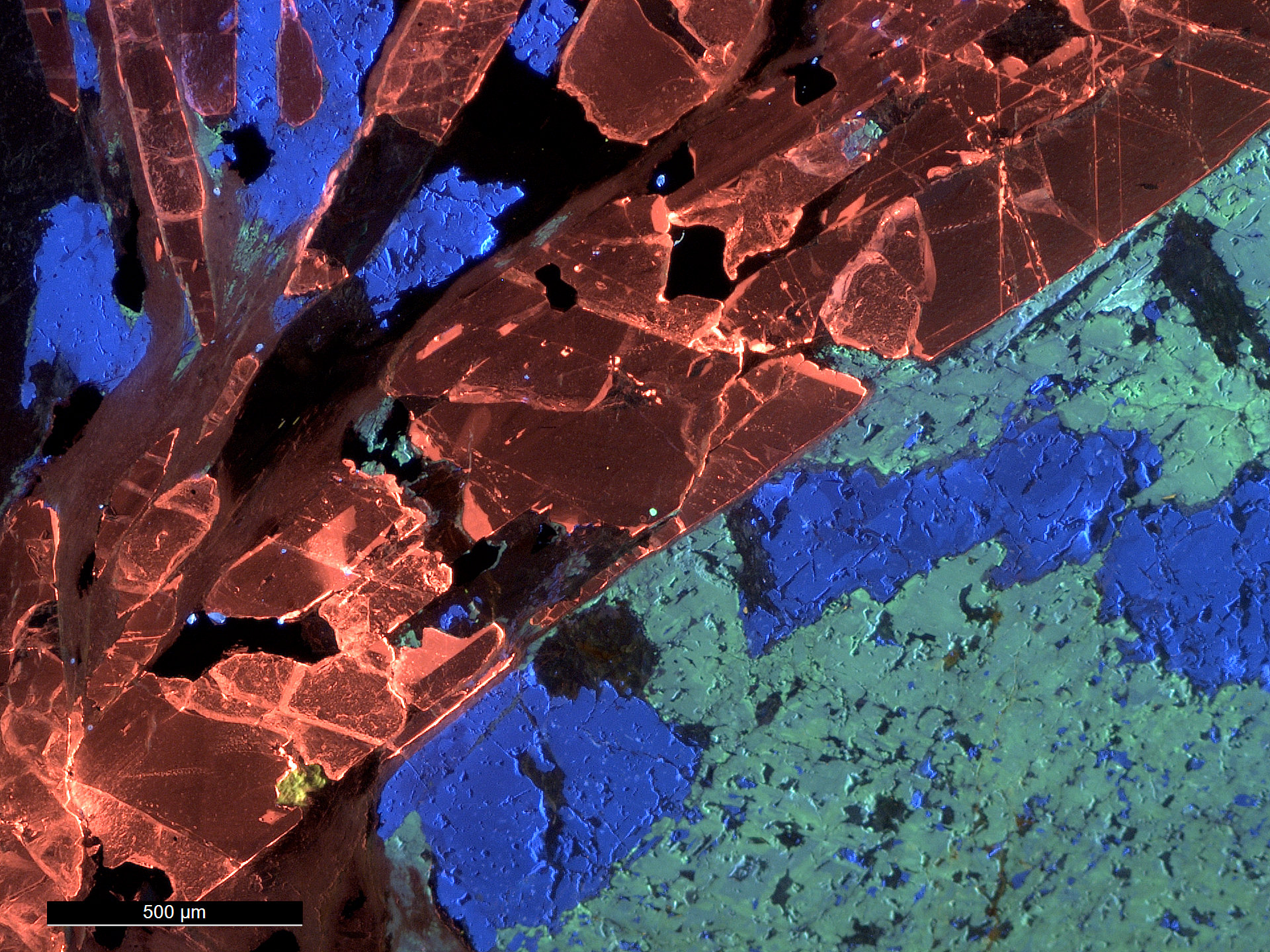
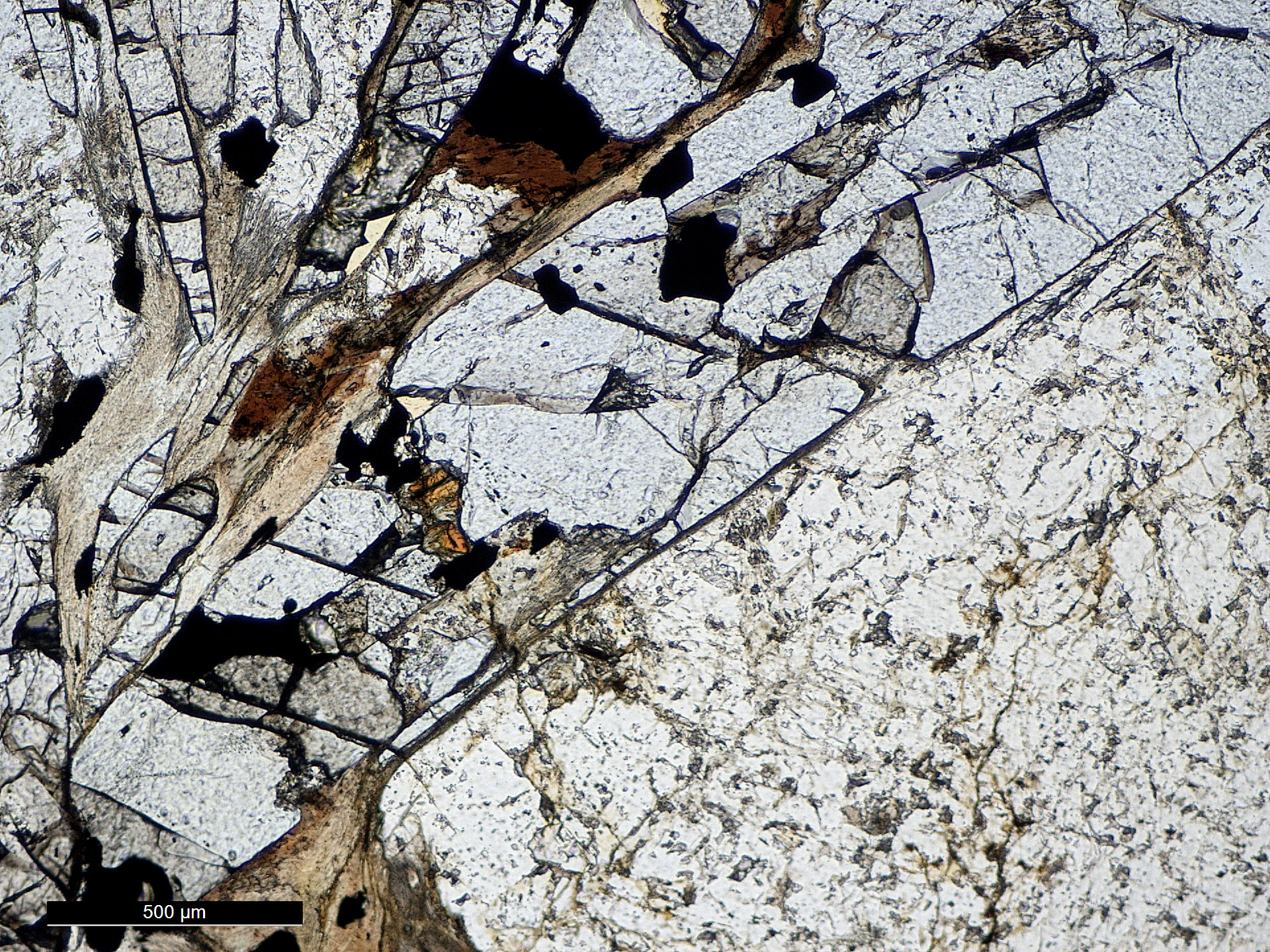
The first example is a CL image of xenotime and associated minerals in peralkaline granite.
Here is a labeled version below. Click on the photo to see a larger version.
This first example is from the paper by:
Chakhmouradian, A. R. and Zaitsev, A. N., Rare Earth Mineralization in Igneous Rocks: Sources and Processes. pp 347-353. Figure 5C.
Second example is from Mariano, A. N. and Mariano, A., Jr. , Rare Earth Mining and Exploration in North America, pp. 369-376. Figure 3C.

This is a Cathodoluminescence micrograph of Sm3+ - activated apatite (light pink) in a dolomite carbonatite matrix (field of view = 2.5 mm).
All three photographs were taken by Dr. Anthony N. Mariano.
Dolomites, Early Ordovician
Added 9/21/12
Dolomites from the Arbuckle Group from the deep subsurface in Kansas
- Formation: Early Ordovician Arbuckle Group at depth > 4,000 feet.
- Scale: The long dimension of the image is 5 cm.
- Photo attribution: Brad King and Wayne Dickerson of the University of Kansas at the Kansas Geological Survey's Digital Cathodoluminescence Imaging Laboratory.
- Blue specks: These are small air bubbles that were trapped in a blue-dyed impregnating epoxy resin. The bubbles are now partly filled with aluminum oxide polishing paste — white in reflected light, but with blue CL luminescence.
(Photo set and description provided by Dr. Greg Ludvigson)
Authigenic Feldspar
Authigenic feldspar in a carbonate rock. The detrital feldspar is the bright blue grain in the center and the authigenic feldspar is the non-luminescing black region surrounding it.
This is one of the very first examples showing the usefulness of CL in studying authigenic feldspars and distinguishing them from their detrital counterparts.
This photo was originally taken by Dr. Miriam Kastner when she worked with Dr. Siever at Harvard in 1972. Dr. Kastner is now a Distinguished Professor of Earth Sciences at Scripps Institute of Oceanography. Recently, she was awarded the prestigious Francis P. Shepard Medal. By SEPM.